
Should you need to reset the root password on a SCO Openserver 5 system, the procedure is quite simple, do the following:
- Boot from your Emergency Boot Disk, if you do not have one, you can download one from here.
- Type the following commands:
mount /dev/hd0root /mnt
/mnt/bin/chroot /mnt /bin/su root
passwd - You should then get the change password prompt:
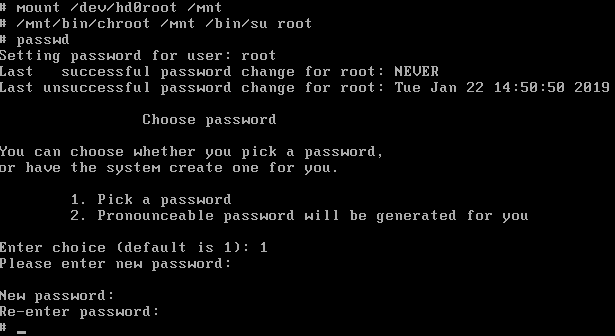
- Then reboot the system with:
sync;sync;sync;reboot - Login with your new root password.
Here is a video of the procedure:
This example was done with SCO Openserver 5.0.7 – I used a virtual 2.88Mb floppy with both boot and root file-system support.
Got SCO running? These tools will make it useful again.
Out of the box, SCO OpenServer 5 can’t talk to modern APIs, can’t back up reliably to a NAS, and can’t run anything beyond stock shell scripts. I’ve compiled a set of modern open-source tools – curl with TLS, rsync, Python 3, bash, GNU coreutils and more.
Once these are in place, your SCO box can back up incrementally to a modern Linux or NAS box, push data to cloud services over HTTPS, and run real automation scripts. None of it requires touching the business application that still needs to run.
Need help with your SCO OpenServer system?
I’ve worked with SCO OpenServer 5 for 20+ years — virtualising ageing hardware, recovering failing servers, modernising legacy output with Microsoft 365 and Power Automate, and helping businesses extract data from systems that were never designed to share it.
If your SCO box still matters to your business, there’s considerably more you can do with it than you might think. Whether you need a quick answer or ongoing support, I’d be glad to hear from you.
Giovanny Andres Aguilar Restrepo says
Where can I download the Emergency Boot Disk?
Paulie says
It’s better if you make you’re own as it will have the controller support you need.
I could upload the generic ones if you want a set.
Mathias Lindqvist says
I would like the generic one please, in img format for use in vmware. Can you help?
Paulie says
Sure, I’ve uploaded them for you:
SCO 5.0.7 Emergency Boot Disk
SCO Openserver 5.0.7 Emergency Root Disk
Hope it works out.
Ricardo says
Hi, I need SCO Openserver 5.0 Emergency Boot Disk